Did you Know Series (7): 100 Rupee Notes ; Classification and Valuation/Historical
Reference:
1) The first hundred rupee notes were issued in Independent India in January 1950
under the signatures of RBI Governor Sir B.Rama Rau (Tenure: 01.07.1949 –
14.01.1957).
The
front of the Note had the details written only in English with a water-mark
window on the left side and Ashoka Pillar (the symbol of Sovereignty of the
Government of India) on the right side. Later issues during his tenure had a
bilingual front side (Hindi and English) and seven (7) other Regional Languages
which had earlier figured on the back of the Notes.
The
reverse design had a pair of adult elephants in a clearing having a sugarcane
field and a forest in the background. (Later designs showed the forest design
slightly altered to showing a bamboo grove and Lotus pond). Initially, the
number of Regional languages depicted on the back of the Note were three (3) to
the left and (3) to the right with Hindi and Urdu in the centre apart from
English.
2)
While minor changes were incorporated on the front side during the tenure of
H.V.R.Iyengar (RBI Governor 01.03.1957- 28.02.1962), a design change took place
in December 1960, on the reverse when the Hirakud Dam & Hydro-electric
Station replaced the earlier elephant and forest/bamboo grove design. The
number of Regional languages was raised to 13 apart from Hindi (official
language of India) and English (subsidiary/additional official language of
India). This design continued with minor variations during the tenure of the
next RBI Governor P.C.Bhattacharya (01.03.1962-30.06.1967).
The
images of the undernoted three notes have been contributed by my sister Raka,
for this post .

The
above design for the 100 rupee notes was released on 26.12.1960 during the
tenure of HVR Iyengar (RBI Governor from 01.03.1957 to 28.02.1962). The size of
this note is 109x172 mm. There are various colours on this note, the
predominant one being Lavender. The prefix (AA/69 on this specimen) is placed
in double lines and mentioned in red colour on the top left hand corner and
diagonally opposite on the bottom right hand corner. There is a circular “100”
numeral on both sides, on one side flanked by “Rs” in English and on the other
by “Ru” in Hindi. The numerals “100” and “RBI” on either side of the Governor’s
signature are in intaglio (incised/raised design). There is a floral design
around the signature and around the words displayed prominently “ONE HUNDRED
RUPEES” in English and “EK SAU RUPIYE” in Hindi.

On
the back, there are thirteen Regional languages along with an image of the
Hirakud Dam and Hydro-Electric station. On the left and right side of the Note
are the words “ONE HUNDRED RUPEES” and the numeral “Rs.100”, while the words
“Ek Sau Rupiye” appear on the top right hand side of the Note. In the bottom
centre is the RBI logo with floral designs.
The
tear in the water-mark window (two holes which look like the masked eyes of a
bandit) is on account of stapling marks which were used to stitch the note
packets together, till RBI introduced the policy that that there will be no
stitching or stapling of Notes in the early 2000s. (I remember that I was
working in the State Bank of India’s Banking Operations Department at the
Corporate Centre, Mumbai, at the material time and all the bundles of currency
notes had to be unstapled, which were kept in the currency chests managed by
the SBI within a time frame stipulated by RBI, which was a herculean task).
The
value of a similar 100 rupee note from this period in mint condition would be
around Rs.4500/- to Rs.7000/- .

The
above is an image of a similar design note as the one whose image is given
before, except that it was issued during the tenure of P.C. Bhattacharya (RBI
Governor from 01.03.1962 to 30.06.1967) , who succeeded Mr. Iyengar .

The
back of the above note exhibiting similar features, as the image of the back of
the Note given before this Note’s images, exhibiting the Hirakud Dam and
Hydro-Electric station.
The
value of this Note in mint condition would be around Rs.Rs.4500/- to about
Rs.5000/- .

This
design released on 17.04.1967 has a large ornamental numeral “100” in the
centre, above which is a bold “ONE HUNDRED RUPEES” in English. On the top left
hand corner is the numeral “100” flanked on either side by “Rs.” in English and
“Ru” in Hindi. On the bottom right hand side is the value of the Note mentioned
in Hindi “Ek Sau Rupiye”. The double prefixed serial number of the Note is
mentioned on the top right hand side and bottom left hand side.

The Back of the above note is similar to the Note images given above, exhibiting
the Hirakud Dam and Hydro-Electric station.
The
value of this Note would be about Rs.1500/- to Rs.2500/-.
3)
During the time of L.K.Jha (RBI Governor 01.07.1957-03.05.1970) a portrait of
Mahatma Gandhi graced the back of the hundred rupee note. This new design was
released on 2nd October 1969, when India was celebrating the Birth
Centenary of Mahatma Gandhi. A slightly differently coloured note but with the
same design and format was issued during the tenure of B.N.Adarkar (RBI
Governor (04.05.1970-15.06.1970).
4)
Later during the tenure of S.Jagannathan (RBI Governor 16.06.1970 -19.05.1975)
a new design 100 rupee note was released on 26th March 1975 , where
the 13 Regional Languages which were hitherto being shown on the back panel
moved to the front side and were placed right next to the water-mark window.
The reverse design portrayed Agricultural work in progress, with ears of wheat
, Hirakud Dam and Hydro-electric Station, two women plucking tea leaves , 3 women planting paddy and a
farmer driving a tractor in a field facilitated by mechanized equipment.
 The above image of the Front of a Rs.100/- Banknote is from the collection of Jayant Biswas.This Banknote was issued during the tenure of RBI Governor I.G.Patel (01.12.1977-15.09.1982). This Banknote issued with an "A" Inset.
 The Back of the above Banknote depicts the Hirakud Dam and Hydroelectric station. This Banknote would be worth about Rs.500/- to Rs.800/-


5)
The words “Satyameva Jayate” appeared below the Lion Capital for the first time
during the tenure of R.N.Malhotra (RBI Governor 04.02.1985-22.12.1990).
6)
The next design change took place during the tenure of Dr.C.Rangarajan (RBI
Governor 22.12.1992 – 22.11.1997). A large portrait of Mahatma Gandhi appeared
on the right hand side of the front panel and his name was spelt out –
“M.K.Gandhi”. Later designs switched his name with “Mahatma Gandhi” which is
continuing till the present day. A few floral motifs and graphic designs
were included and the Lion capital symbol with the words “Satyameva Jayate”
moved to the bottom – left side of the watermark window. On the back side, a
panorama of the glorious Himalayan Ranges/mountains replaced the earlier
design. The number of Regional languages depicted on the panel rose to fifteen
(15). This design scheme both front and back is still found on your present day
100 rupee notes.
Present
day 100 rupee notes in circulation :

The
above is a 100 Rupee Note issued under Dr. Bimal Jalan’s signature (RBI
Governor 22.11.1997 to 06.09.2003). If you will look at the serial number
of the Note ‘2UK’ is the Prefix, the serial No. is ‘792524’. There is the
letter “F”of the alphabet mentioned in the background of the serial
number. Hence, this note is said to have been issued with an “F” Inset.

The
back of the above Note has no year of issue mentioned on it, (year of issue was
mentioned on the back of 100 rupee currency Notes from 2005 onwards).

The
above is a 100 Rupee Note issued under Dr. Jalan’s signature with an “L” inset.

The
back of the above Note shows no year of issue mentioned on it and looks exactly
the same as the back of the “F” Inset note shown above.

The
above is an image of a 100 Rupee Note issued under Dr. Jalan’s signature with a
“B” Inset.

The
back of the above Note showing no year of issue mentioned on it and looks
exactly the same as the back of the “F” Inset note shown above.

The
above is an image of a 100 Rupee Note issued under Dr. Jalan’s signature with a
“R” Inset.

The
back of the above Note showing no year of issue mentioned on it and looks
exactly the same as the back of the “F” Inset note shown above.
From
the above examples, it is clear that as Dr. Jalan’s tenure as RBI Governor
ended in September 2003, none of the 100 Rupee Notes issued under his signature
bear the year of issue on the back.
100
rupee Notes were also issued under Dr. Jalan’s tenure with “Plain Inset” and
“E” Inset.
Notes
issued under Dr. Jalan’s signatures in mint fresh condition are valued by
Collectors at anywhere between Rs.250/- to Rs.350/- (for the later issues and
Rs.300/- to Rs.500/- (for the earlier issues).
The
following Notes were issued under the signatures of Dr.Y.V.Reddy (RBI Governor
from 06.09.2003 to 05.09.2008):

The above is an image of a 100 Rupee
Note issued under Dr. Reddy’s signature with an “E” Inset in 2005.

The
back of the above Note showing 2005 (below the image of the Himalayan Ranges)
as the year of issue mentioned on it.

The above is an image of a 100 Rupee Note issued under Dr.
Reddy’s signature with an “E” Inset in 2007.

The
back of the above Note showing 2007 (below the image of the Himalayan Ranges)
as the year of issue mentioned on it.

The above is an image of a 100 Rupee Note issued under Dr.
Reddy’s signature with an “E” Inset in 2008.

The back of the above Note showing 2008 (below the image of the Himalayan Ranges) as the year of issue mentioned on it.
(“E”
Inset 100 rupee notes were also issued in 2006).

The
above is an image of a 100 Rupee Note issued under Dr. Reddy’s signature with
“Plain Inset” during the early part of his tenure.

The
back of the above Note showing no year of issue mentioned on it.

An
image of a 100 Rupee Note issued under Dr. Reddy’s signature with “Plain Inset”
during 2007.

The
back of this Note with a “Plain Inset” shows the year of issue as 2007
mentioned on it.

An image of a 100 Rupee Note issued under Dr. Reddy’s signature with “Plain Inset” during 2008.

The
back of this Note with a “Plain Inset” shows the year of issue as 2008
mentioned on it.
(Plain
Inset 100 Rupee Notes were also issued in 2005 and 2006 during Dr. Reddy’s
tenure).

The
above is an image of a 100 Rupee Note issued under Dr. Reddy’s signature with
“R” Inset issued during 2006.

The
back of the above Note showing 2006 as the year of issue, below the Himalayan
Ranges image.
(100
rupee Notes with “R” Inset were also issued in 2005 and 2007 and with no year
mentioned on the back, during the early part of Dr. Reddy’s tenure.

The
front of a 100 rupee Note issued with Dr. Reddy’s signature with an “A” Inset
in 2008.

The
back of the above Note showing the year of issue as 2008. ( “A” Inset Notes
were issued in 2008 only during Dr. Reddy’s tenure).

The
above image is of a Rs.100/- Note issued under Dr. Reddy’s signature with an
“L” Inset in 2008.

The
back of the above Note showing 2007 as the year of issue.
(100
Rupee Notes with “L” Inset were also issued during the early part of Dr.
Reddy’s tenure with no year mentioned on the back, or with 2005,2006 and 2008
mentioned on the back).
During
2003 and 2004 , 100 rupee Notes were also issued under Dr. Reddy’s signature
with “F” and “G” Insets ( with no year mentioned on the back) and with
“S” Inset during 2008 before the end of his tenure.


The Front and Back of a 100 Rupee Note with "S" Inset issued during 2008 during Dr. Reddy's tenure.
The value of the
Notes issued during Dr. Reddy’s tenure is about Rs.150/- to Rs.250/- for mint
fresh notes for the later years and Rs. 300/- to Rs.400/- for the earlier
issues in mint fresh condition.
The
following Notes were issued under the signatures of Dr.D.Subbarao (RBI
Governor from 05.09.2008 to Present Day).

An
image of a 100 Rupee Note issued under Dr. D.Subbarao’s signature with “Plain
Inset” during 2009.

An
image of the back of the above Note, showing the year of issue as 2009 below
the picture of the Himalayan Ranges.

An
image of a 100 Rupee Note issued under Dr. D.Subbarao’s signature with “Plain
Inset” during 2010.

The
back of the above Note showing the year of issue as 2010.

An
image of a 100 Rupee Note issued under Dr. D.Subbarao’s signature with “Plain
Inset” during 2011.

The
back of the above Note showing the year of issue as 2011.
(Notes
with Plain Inset were also issued in 2008 during Dr. Subbarao’s tenure).


The
front and back of a 100 rupee note issued with "L" Inset during 2011 under Dr. Subbarao,s
signature during 2011.

An
image of a 100 Rupee Note issued under Dr. D.Subbarao’s signature with “R”
Inset during 2011.

The
back of the above Note showing the year of issue as 2011.
(“R”
Inset notes were also issued during 2009 and 2010 during Dr. Subbarao’s tenure
so far).

An
image of a 100 Rupee Note issued under Dr. D.Subbarao’s signature with “F”
Inset during 2009.

The
back of the above Note showing the year of issue as 2009.

An
image of a 100 Rupee Note issued under Dr. D.Subbarao’s signature with “F”
Inset during 2010.

The
back of the above Note showing the year of issue as 2010.


The above are images of a 100 Rupee note issued with "G" Inset during 2011 during Dr. Subbarao's tenure without the rupee symbol. This is only the second time during its entire history of printing that a "G" Inset has been used on a 100-Rupee Note.
The
value of all these Notes for collectors is about Rs.150/- to Rs. 200/- for the
earlier issues during Dr. Subbarao’s tenure progressively becoming lesser for
the later issues.
Recently,
the Reserve Bank of India in its periodical design changes has introduced new
Currency Notes in the denominations of Rs.1000/-, Rs.500/-, Rs.100/-, Rs.50/-, Rs.20/- and
Rs.10/-. The Old design on the currently circulating Mahatma Gandhi Notes
has been retained in the new series, but the new “Rupee symbol” has been
introduced in two places on the front side just before the denomination of the
currency note as well as , before two denomination numerals on the top of the
back of the Notes.
I
happened to acquire two five hundred notes with the rupee symbol and ten one
hundred rupee notes from a Bank ATM near my residence on the 01.01.2012 which
had placed these new design notes in their ATM as a “New Year’s Gift” to
customers. I happened to be the first one to receive these notes. Later on,
while passing through the same area, I saw that the ATM withdrawal line had
really built up to a serpentine queue and the ATM cash was being reloaded which
meant that the message to collect the new design notes had spread fast!!
Also,
I acquired two ten rupee Notes from a provision shop which had no idea that the
‘00E” prefix meant that these were the very first issues. The Rs.500/- note has an ”8AD” prefix while the Rs.100/- note has an “1AK” prefix which means that these notes
are one of the first few issues as well.


The above images are that of a 100-rupee Note issued in 2011 under
Dr.Subbarao's signature, with an "R" Inset in its serial number.
The following are the Front and back of a rupee symbol 100-rupee Note issued in 2012. Notice that the year 2012 is mentioned at the back of the second image , just below the picture of the Himalayan Ranges and the Note carries the Rupee symbol just before the numerals "100".
The following are the Front and back of a rupee symbol 100-rupee Note issued in 2012. Notice that the year 2012 is mentioned at the back of the second image , just below the picture of the Himalayan Ranges and the Note carries the Rupee symbol just before the numerals "100".


The undernoted image is of a Rs.100/- note issued in 2012 with an "F" Inset. Notice that the Rupee symbol has not been included in this issue. The Note bears the signatures of D. Subbarao, the present RBI Governor.


The back of the above note showing the year of issue as 2012, below the picture of the Himalayan Ranges. Thus, we can easily see that both Series of Notes i.e. with the Rupee symbol and without are being issued at present.

The above image is of a Rs.100/- note issued in 2012 with an "G" Inset, but without the Rupee symbol.
Given below are images of the Front of Rs 100 notes issued in 2013, with a Plain Inset, "L" Inset and "R" Insets, all issued with the Rupee symbol.


Given below is a representative example of the Back of the above 3 Notes, showing the year of issue as 2013:

Star Series Banknotes:
Whenever defective
notes are printed, particularly from Rs.10/- to Rs.100/- denominations, the
Security Printing Presses have adopted a “Star” series numbering system for
replacement of these defectively printed Notes.
The numbering on the replacement Notes is exactly like the normally printed ones, but have an additional feature i.e. a “STAR” (*) is added in the serial number in the space between the prefix and the number.
The main significance of these notes, besides the “STAR” is that, although, these notes would be issued in packets of 100 each, these bank notes would not be serially numbered.
To enable easy identification, the bands on these packets will clearly indicate that the packet contains star-series banknotes. The notation on the band of such note packets normally is “contains non-serially numbered notes with * in the number panel”, both in Hindi and English.
The numbering on the replacement Notes is exactly like the normally printed ones, but have an additional feature i.e. a “STAR” (*) is added in the serial number in the space between the prefix and the number.
The main significance of these notes, besides the “STAR” is that, although, these notes would be issued in packets of 100 each, these bank notes would not be serially numbered.
To enable easy identification, the bands on these packets will clearly indicate that the packet contains star-series banknotes. The notation on the band of such note packets normally is “contains non-serially numbered notes with * in the number panel”, both in Hindi and English.

The
above is an image of a ten rupee note containing a “star” * in the number
panel, issued in 2010 with an “M” Inset, collected for me from general
circulation by Krishna Tonpe.
The
value of such notes in mint condition increases substantially from say, about
7-10 times the face value, to about a few thousands of rupees , depending on
its value for collectors and the serial number it contains/ Inset etc.


The
above is an image of a hundred rupee note containing a “star” * in the number
panel, issued in 2011 with an “L” Inset collected by me through general circulation from a Provision store.
Posted on 26.02.2014:
I was pleasantly surprised to receive the undernoted Rs.100/- Star Series Banknote in almost uncirculated condition from a Shopping Mall today!!
 This Banknote too has an "L" Inset, however this has been issued in 2013. This is one of the last few * "Star" series banknotes issued under the signature of RBI Governor D. Suubarao who has relinquished office in late 2013.

Posted on 04.09.2013
Posted on 26.02.2014:
I was pleasantly surprised to receive the undernoted Rs.100/- Star Series Banknote in almost uncirculated condition from a Shopping Mall today!!
Posted on 04.09.2013
An Error Note:

The above is the image of an error Rs.100/- Banknote, sent to me by Dhruv Kumar Seth, a collector from Lucknow. This Note is issued with a "F" Inset during the tenure of RBI Governor Bimal Jalan. Notice that only the "F" Inset is printed on the top right hand corner of the Note and only the numeral "4" appears, whereas the prefix as well as the Serial number is missing. An error Banknote like this in Mint condition would be worth several times more than its face value.
Posted on 23.01.2014:
Reserve Bank of India has now decided to withdraw all currency notes issued prior to 2005, without specifically mentioning that these Banknotes will cease to be legal tender. From April 2014 all Banks will accept and exchange pre-2005 Banknotes. These Banknotes are easily identified by the absence of the year of printing on the Back of the Note. RBI estimates that the maximum number of fake currency Banknotes are from the period prior to 2005. From 01.07.2014, to exchange more than 10 pieces of Rs.500/- and Rs.1000/- banknotes, non-customers will have to furnish identity and address proof to the Bank Branch. However, it is expected that later on RBI will issue a communication advising users the final date upto which Banknotes prior to 2005 will be accepted by the Bank.
Therefore, please start examining the year of issue" at the back of the currency Notes passing through your hands, so as not to face the inconvenience of going to a Bank Branch for returning the currency issued prior to 2005.
While this is a welcome step, RBI needs to have a policy in place to take the remaining counterfeit Banknotes issued after 2005, like changing/revamping the Front and Back designs, adding more effective security features etc. so as not to put users at risk of accepting counterfeit currency Banknotes.
Posted on 03.03.2014:
Posted on 26.05.14:
After a long wait, I have acquired three 100 Rupee Notes signed by the present RBI Governor Raghuram G. Rajan, thanks to my friend Jayant who got them from an ATM only yesterday. What makes this "acquisition" more interesting is the fact that it is my first 100 Rupee Note which has been issued in 2014.
 The Front of the Rs.100/- Banknote signed by Raguram G. Rajan issued in 2014 with an "L" inset.
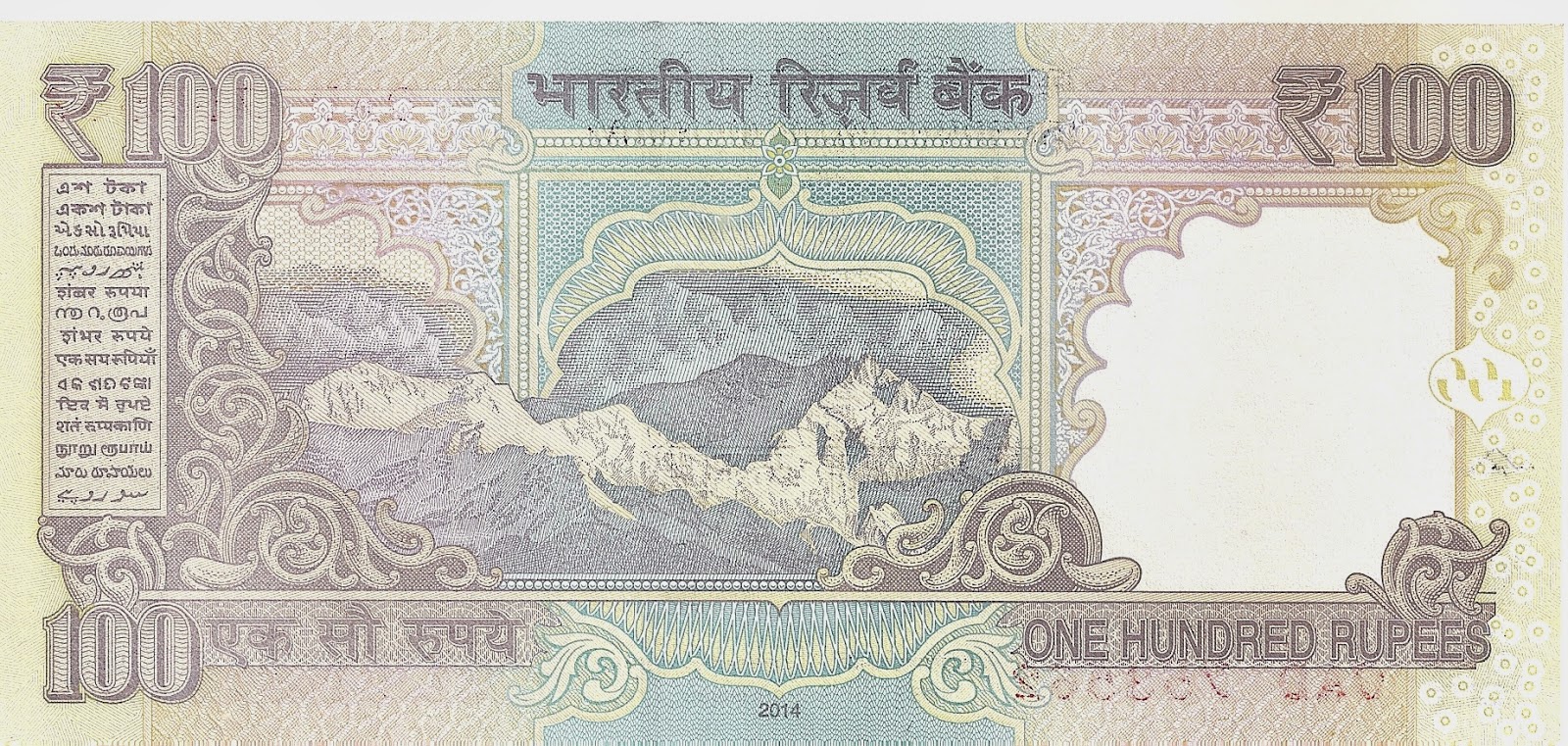 The Back of the above Banknote showing the year of issue as 2014.
Posted on 31.07.14:
I got the following Banknote from an ATM today signed by RBI Governor Rajan issued with an "E" Inset:
 The Front of the Rs.100/- Banknote signed by Raguram G. Rajan issued in 2014 with an "E" Inset.
 The Back of the above Banknote showing the year of issue as 2014.
Posted on 21.09.14:
I collected the following Banknote from an ATM today signed by RBI Governor Rajan issued with a "Plain" Inset:
 The Front of the Rs.100/- Banknote signed by Raguram G. Rajan issued in 2014 with a "Plain" Inset.
 The Back of the above Banknote showing the year of issue as 2014.
 The Front of the Rs.100/- Banknote signed by Raguram G. Rajan issued in 2014 with an "R" Inset.

The Back of the above Banknote showing the year of issue as 2014.
Posted on 31.12.14:
The Reserve Bank of India (RBI) has extended the deadline for turning in pre-2005 Banknotes to 30.06.2015. While these Banknotes would be treated as legal tender upto this period, but RBI would destroy them as and when they come into Bank branches.
RBI has sought the general public’s cooperation and urged them to deposit the old design Banknotes in their Bank accounts or exchange them at a bank branch convenient to them.
RBI has further mentioned that the Banknotes can be exchanged for their full value till this date. Check out all your Banknotes and deposit all such Banknotes ( i.e. without the year of issue printed at the back) at convenient Bank branches before the scheduled date.
Posted on 26.02.2015:
Dennis and Maggie are visiting us from 24.02.2015. I have been given a "Star" series Banknote by Maggie for my collection, details as under:
 The above is a Star Series Banknote numbered "2CM*208117" issued with an "E" Inset during the tenure of RBI Governor D. Subba Rao in 2013.
 The Back of the above Banknote showing the year of issue as 2013.
Posted on 18.06.2015:
Two Star Series Banknotes as under have been given for my collection by Krishna Tonpe a few days back, which are as under:
 The
above is a Star Series Banknote numbered "0BB*111754" issued with an
"E" Inset during the tenure of RBI Governor Raghuram Govind Rajan in 2014. Although a bit crumpled, this is my first Star Series Banknote of RBI Governor Rajan.
The
above is a Star Series Banknote numbered "0BB*111754" issued with an
"E" Inset during the tenure of RBI Governor Raghuram Govind Rajan in 2014. Although a bit crumpled, this is my first Star Series Banknote of RBI Governor Rajan.

The Back of the above Banknote showing the year of issue as 2014.

The above is a Star Series Banknote numbered "4CC*281738" issued with an "L" Inset during the tenure of RBI Governor D.Subba Rao in 2013 which has become rather crumpled and worn out with circulation.
 The Back of the above Banknote showing the year of issue as 2013.
Posted on 26.06.2015:
The Reserve Bank of India has issued ₹ 100 denomination banknotes in Mahatma Gandhi Series – 2005 with a new numbering pattern. Now the numerals in both the number panels of these banknotes will be in ascending size from left to right, while the first three alphanumeric characters (prefix) will remain constant in size.
Printing the numerals in ascending size is a visible security feature in the banknotes so that the general public can easily distinguish a counterfeit note from a genuine one.
The Reserve Bank, in consultation with Government of India, has been improving security features of Indian banknotes so as to make their counterfeiting difficult and make it easy for members of public to identify genuine banknotes.
The design of banknotes with numerals in ascending size is similar in all other respects to the current design of ₹100 banknotes in Mahatma Gandhi Series – 2005 except for the new numbering pattern.
The banknotes will continue to have "₹" symbol on the obverse and the reverse, an inset letter 'R' in both the numbering panels, bear the signature of Dr. Raghuram G. Rajan, Governor, Reserve Bank of India, and the year of printing '2015' printed on the Back of the banknotes.
Also posted on 26.06.2015:
The Reserve Bank of India has extended the date for the public to exchange their pre-2005 banknotes till December 31, 2015.
The Reserve Bank has stated that the notes can be exchanged for their full value. It has also clarified that all such notes continue to remain legal tender.
Soliciting cooperation from members of public in withdrawing these banknotes from circulation, the Reserve Bank of India has urged them to deposit the old design notes in their bank accounts or exchange them at a bank branch convenient to them.
Posted on 30.06.2015: Today, I acquired a Rs.100/- Banknote signed by RBI Governor Raghuram G. Rajan issued with the year of printing as "2015" with a "Plain" Inset" in which the old design Serial Number pattern/print has been used.
Banknotes of this type would soon be superseded by Rs.100/- Banknotes where the numerals in both the number panels will be printed in ascending size from left to right, while the first three alphanumeric characters (prefix) will remain constant in size are going to be in circulation very shortly.
The old design Banknotes with the year of issue as 2015, should generate Collector's interest, as these would be very few in number.
 The Front of the Rs.100/- Banknote signed by Raguram G. Rajan issued in 2015 with a "Plain" Inset.
 The Back of the above Banknote showing the year of issue as 2015.
Posted on 16.08.2015:
Acquired my second Star series Rs.100/- banknote signed by RBI Governor Raghuram G. Rajan, contributed for my collection by Mita Banerjee yesterday:
 The
above is a Star Series Banknote numbered "1CC*189587" issued with an
"L" Inset during the tenure of RBI Governor Raghuram Govind Rajan in 2014. This Banknote is in mint fresh condition.
The
above is a Star Series Banknote numbered "1CC*189587" issued with an
"L" Inset during the tenure of RBI Governor Raghuram Govind Rajan in 2014. This Banknote is in mint fresh condition.
 The Back of the above Banknote showing the year of issue as 2014.
Posted on 01.09.2015:
Yesterday, Jayant acquired a few Rs.100/- Banknotes where the numerals in both the number panels are printed in ascending size from left to right, while the first three alphanumeric characters (prefix) have remained constant in size. It was announced by the Reserve Bank of India that Banknotes in the Rs.100/- denomination will be put into circulation with this novel numbering method. He immediately shared a few of these Banknotes with me for my collection:
 The above Banknote has been with a Plain Inset issued in 2015 under RBI Governor Raghuram G. Rajan's signatures. Notice how the size of the prefix "6AE" has remained constant, while the numerals "875745" in both the number panels are printed in
ascending size from left to right.
The above Banknote has been with a Plain Inset issued in 2015 under RBI Governor Raghuram G. Rajan's signatures. Notice how the size of the prefix "6AE" has remained constant, while the numerals "875745" in both the number panels are printed in
ascending size from left to right.
Posted on 02.10.2015:
 Illustrations of Rs.500/- and Rs. 1000/- Banknotes with the new designs and explanation.
Posted on 23.12.2015:
I have yesterday received the undernoted Banknote from Hirakda (Mr. Hirak Mukherjee) which exhibits the exploding font Serial numbers, but no Bleed lines:
 The above is an image of a Rs.100/- Banknote , bearing an "R" Inset
and Serial No. OBE 860700 , in an "Exploding Font" format, but not
exhibiting the four "Bleed lines", which have been introduced in later
Banknotes which are now going to be in circulation. Banknotes like the
one above are a kind of "experimental Banknotes" with "Exploding Fonts"
which have been introduced by RBI in very small quantities and are much
sought after by Banknote Collectors.
The above is an image of a Rs.100/- Banknote , bearing an "R" Inset
and Serial No. OBE 860700 , in an "Exploding Font" format, but not
exhibiting the four "Bleed lines", which have been introduced in later
Banknotes which are now going to be in circulation. Banknotes like the
one above are a kind of "experimental Banknotes" with "Exploding Fonts"
which have been introduced by RBI in very small quantities and are much
sought after by Banknote Collectors.

The Back of the above Banknote shows the year of issue as "2015" and exhibits no change from earlier/later issues.
Posted on 06.02.2016: Ayesha and Zaheer Hasan have sent me the following interesting images of some error Banknotes:
 The Front of the above Banknote bearing Serial No. 6WP 181508 issued with an "L" Inset, during the tenure of RBI Governor Bimal Jalan bears the Serial number in the bottom left hand corner only, but only the "L" Inset has been printed on the top right hand corner but the Serial number has been erroneously omitted to be printed.
 The Back of the above Banknote, however, exhibits normal/regular print features
 The Front of the above Banknote bearing Serial No. 0BT 336817 issued with an "A" Inset, during the tenure of RBI Governor C.Rangarajan exhibits normal/regular print features
 On the Back however, there is a reverse print of the Mahatma Gandhi Portrait, the name of the Reserve Bank of India, the numeral 100, as well as, the Government Guarantee Clause and the RBI Governor's signature et al.

The Front of the above Banknote bearing Serial No. 7BD 251844 issued with an "L" Inset, during the tenure of RBI Governor Y.V. Reddy shows a split print error on the right hand side due to the shifting of the Printing paper.
 The print on the Back of the above Banknote too has been sliced at the extreme right hand lower end because of the print shift error.
 The Front of the above Banknote bearing Serial No. 2FE 690164 issued with an "E" Inset, during the tenure of RBI Governor Bimal Jalan which shows the effects of a downward print shift in which the inset "E" print has shifted downwards, with all other print features on the Banknote remaining more or less in position.
 The Back of the above Banknote shows an interesting impression of the numeral "100" printed in half on the top left hand corner due to the downward print shift, which should have actually been printed on the Back of the next Banknote.
Posted on 23.01.2014:
Reserve Bank of India has now decided to withdraw all currency notes issued prior to 2005, without specifically mentioning that these Banknotes will cease to be legal tender. From April 2014 all Banks will accept and exchange pre-2005 Banknotes. These Banknotes are easily identified by the absence of the year of printing on the Back of the Note. RBI estimates that the maximum number of fake currency Banknotes are from the period prior to 2005. From 01.07.2014, to exchange more than 10 pieces of Rs.500/- and Rs.1000/- banknotes, non-customers will have to furnish identity and address proof to the Bank Branch. However, it is expected that later on RBI will issue a communication advising users the final date upto which Banknotes prior to 2005 will be accepted by the Bank.
Therefore, please start examining the year of issue" at the back of the currency Notes passing through your hands, so as not to face the inconvenience of going to a Bank Branch for returning the currency issued prior to 2005.
While this is a welcome step, RBI needs to have a policy in place to take the remaining counterfeit Banknotes issued after 2005, like changing/revamping the Front and Back designs, adding more effective security features etc. so as not to put users at risk of accepting counterfeit currency Banknotes.
Posted on 03.03.2014:
The Reserve Bank of India has extended the date for
exchanging the pre-2005 banknotes to January 01, 2015. It has also advised
banks to facilitate the exchange of these notes for full value and without
causing any inconvenience whatsoever to the public.
RBI has
further clarified that the public can continue to freely use these notes for
any transaction and can unhesitatingly receive these notes in payment, as all
such notes continue to remain legal tender till that date.Posted on 26.05.14:
After a long wait, I have acquired three 100 Rupee Notes signed by the present RBI Governor Raghuram G. Rajan, thanks to my friend Jayant who got them from an ATM only yesterday. What makes this "acquisition" more interesting is the fact that it is my first 100 Rupee Note which has been issued in 2014.
Posted on 31.07.14:
I got the following Banknote from an ATM today signed by RBI Governor Rajan issued with an "E" Inset:
Posted on 21.09.14:
I collected the following Banknote from an ATM today signed by RBI Governor Rajan issued with a "Plain" Inset:
The Back of the above Banknote showing the year of issue as 2014.
Posted on 31.12.14:
The Reserve Bank of India (RBI) has extended the deadline for turning in pre-2005 Banknotes to 30.06.2015. While these Banknotes would be treated as legal tender upto this period, but RBI would destroy them as and when they come into Bank branches.
RBI has sought the general public’s cooperation and urged them to deposit the old design Banknotes in their Bank accounts or exchange them at a bank branch convenient to them.
RBI has further mentioned that the Banknotes can be exchanged for their full value till this date. Check out all your Banknotes and deposit all such Banknotes ( i.e. without the year of issue printed at the back) at convenient Bank branches before the scheduled date.
Posted on 26.02.2015:
Dennis and Maggie are visiting us from 24.02.2015. I have been given a "Star" series Banknote by Maggie for my collection, details as under:
Posted on 18.06.2015:
Two Star Series Banknotes as under have been given for my collection by Krishna Tonpe a few days back, which are as under:


The Back of the above Banknote showing the year of issue as 2014.

The above is a Star Series Banknote numbered "4CC*281738" issued with an "L" Inset during the tenure of RBI Governor D.Subba Rao in 2013 which has become rather crumpled and worn out with circulation.

Posted on 26.06.2015:
The Reserve Bank of India has issued ₹ 100 denomination banknotes in Mahatma Gandhi Series – 2005 with a new numbering pattern. Now the numerals in both the number panels of these banknotes will be in ascending size from left to right, while the first three alphanumeric characters (prefix) will remain constant in size.
Printing the numerals in ascending size is a visible security feature in the banknotes so that the general public can easily distinguish a counterfeit note from a genuine one.
The Reserve Bank, in consultation with Government of India, has been improving security features of Indian banknotes so as to make their counterfeiting difficult and make it easy for members of public to identify genuine banknotes.
The design of banknotes with numerals in ascending size is similar in all other respects to the current design of ₹100 banknotes in Mahatma Gandhi Series – 2005 except for the new numbering pattern.
The banknotes will continue to have "₹" symbol on the obverse and the reverse, an inset letter 'R' in both the numbering panels, bear the signature of Dr. Raghuram G. Rajan, Governor, Reserve Bank of India, and the year of printing '2015' printed on the Back of the banknotes.
Also posted on 26.06.2015:
The Reserve Bank of India has extended the date for the public to exchange their pre-2005 banknotes till December 31, 2015.
The Reserve Bank has stated that the notes can be exchanged for their full value. It has also clarified that all such notes continue to remain legal tender.
Soliciting cooperation from members of public in withdrawing these banknotes from circulation, the Reserve Bank of India has urged them to deposit the old design notes in their bank accounts or exchange them at a bank branch convenient to them.
Posted on 30.06.2015: Today, I acquired a Rs.100/- Banknote signed by RBI Governor Raghuram G. Rajan issued with the year of printing as "2015" with a "Plain" Inset" in which the old design Serial Number pattern/print has been used.
Banknotes of this type would soon be superseded by Rs.100/- Banknotes where the numerals in both the number panels will be printed in ascending size from left to right, while the first three alphanumeric characters (prefix) will remain constant in size are going to be in circulation very shortly.


Posted on 16.08.2015:
Acquired my second Star series Rs.100/- banknote signed by RBI Governor Raghuram G. Rajan, contributed for my collection by Mita Banerjee yesterday:


Posted on 01.09.2015:
Yesterday, Jayant acquired a few Rs.100/- Banknotes where the numerals in both the number panels are printed in ascending size from left to right, while the first three alphanumeric characters (prefix) have remained constant in size. It was announced by the Reserve Bank of India that Banknotes in the Rs.100/- denomination will be put into circulation with this novel numbering method. He immediately shared a few of these Banknotes with me for my collection:

Posted on 02.10.2015:
On 24.09.2015, Reserve
Bank of India (RBI) has notified that
Banknotes in the Mahatma Gandhi series 2005 are being issued with a new
numbering pattern and special features for the visually challenged persons in
the denominations of Rs.100/-, Rs.500/- and Rs.1000/-.
These new design Banknotes
will contain a new numbering pattern in which the numerals in both the number
panels will ascend in size from left to right, while the first three
alphanumeric characters (prefix) will remain constant in size. Printing of the
numerals in ascending sizes (also called exploding font) is a visible security
feature in the Banknotes so that users can easily distinguish counterfeits from
genuine Banknotes.
Special features have been
included for the visually challenged persons in order to make it easier for
them to identify different denominations of Banknotes:
The
size of the identification mark in Rs.100/- (triangle), Rs.500/-(circle) and
Rs.1000/- (diamond) denominations has been increased by 50 per cent and angular
“bleed lines” – 4 lines in 2 blocks in Rs.100/-, 5 lines in 3 blocks in Rs.500
(2-1-2) and 6 lines in Rs.1000/- (1-2-2-1) denominations have been introduced. (All
these lines will be printed using intaglio printing – which is a state–of–the–art
technology in which the security paper is perforated and printing ink is
incised into the paper). Visually challenged persons will be able to feel these
lines more easily so as to recognise the denomination/value of these Banknotes
and easily distinguish between fake and genuine Banknotes.

The design of Banknotes of
these 3 denominations is similar in all respects to the earlier issues of the
Mahatma Gandhi 2005 Series.
RBI has further advised
that all the Banknotes in these denominations issued by RBI earlier will
continue to be legal tender except those printed brior to 2005 which cease to
be legal tender wef 31.12.2015.
In addition to these
security features these Banknotes will have moving images and colour variations
with distinct contrasts visible to the naked eye when tilted at different angles,
while some security features will be invisible to the naked eye and be only
machine readable.
These additional security features will
strengthen the recently introduced Banknotes on an experimental basis where
Rs.100/- and Rs.500/- Banknotes have been issued for general circulation with
numerals in ascending size from left to right in the number panels but without
the bleed lines.
These
measures are being taken so as to raise the bar for counterfeiters and make it
extremely difficult, if not impossible, to print fake Indian Currency
Banknotes.
Dennis has forwarded this communication jointly released by the Ministry
of Consumer Affairs, Food and Public Distribution and Reserve Bank of
India which aims at familiarising the users with the new changes which
are in place in the currency notes of Rs.100/- Rs.500/- and Rs. 1000/-
denominations which we will all be using in the near future. Already
Banknotes of these designs are being put into circulation and you may
come across them in daily usage.


Posted on 23.12.2015:
I have yesterday received the undernoted Banknote from Hirakda (Mr. Hirak Mukherjee) which exhibits the exploding font Serial numbers, but no Bleed lines:


Posted on 06.02.2016: Ayesha and Zaheer Hasan have sent me the following interesting images of some error Banknotes:


The Front of the above Banknote bearing Serial No. 7BD 251844 issued with an "L" Inset, during the tenure of RBI Governor Y.V. Reddy shows a split print error on the right hand side due to the shifting of the Printing paper.


The Front of this Banknote bearing Serial No. 1HF 891383 with "E" Inset printed during the tenure of RBI Governor C. Rangarajan has the print shifting towards the right but just about keeping the Serial number on the top right hand corner intact.

The effect of the Print shift on the print at the Back has just about kept the language panel on the left hand side intact. Whew!!
Posted on 03.05.2016:
I have received my first new design Rs.100/- Banknote from Ankita who has contributed this Banknote for my collection. This Banknote exhbits all the recently introduced features - "Exploding Font" or "Ascending Serial Numbers", Four "Bleed lines" on either side of the front of the banknote, bigger visual identification Assist "triangle" which has been shifted upwards from previously issued Banknotes etc. These enhanced security features have "raised the bar for counterfeiters". Get ready to use similar Banknotes in the coming days:

The Front of a Rupees 100 Banknote exhibiting all the recently introduced features - Four Bleed lines in a "2 - 2" format, Exploding Font or Ascending Serial number "5AD 589081" (the Banknote has an "E" Inset).

The Back of the above Banknote exhibits the identical features of Banknotes already/presently in circulation. The year of issued is marked as "2015".
Posted on 09.05.2016:
These Banknote images have been contributed by Zaheer Hasan for illustration:
Given below is an image of a Rs.100/- Banknote issued in the earlier design but bearing the year of issue as "2016":
 The Front of the above Banknote which has been issued with the Serial Number - 1UT 364525 with a "Plain Inset" in the old design format, but during 2016.
 The Back of the above Banknote showing the Year of issue as "2016".
It seems that you may also come across some Banknotes in the earlier design format during 2016 , till such time that all the SPMCIL/RBI Printing Presses have been migrated/switched over to the new Design.
 The
Front of the above Banknote which has been issued with the Serial
Number - "3AA 283513" with an "R" Inset in the new design format, with exploding fonts and four Bleed lines
during 2015.
The
Front of the above Banknote which has been issued with the Serial
Number - "3AA 283513" with an "R" Inset in the new design format, with exploding fonts and four Bleed lines
during 2015.
 The Back of the above Banknote showing the year of issue as "2015".

The Front of the above Banknote which has been issued with the Serial Number - "6CH 825346" with an "R" Inset in the new design format, with exploding fonts and four Bleed lines during 2016.
 The Back of the above Banknote showing the year of issue as "2016".
Posted on 02.06.2016:
I have acquired a Rs.100/- Banknote with an "E" Inset and the new design, yesterday from a Provision Store merchant bearing the year of issue as 2016:
 The
Front of the above Banknote which has been issued with the Serial
Number - "3BL 383079" with an "E" Inset in the new design format, with exploding fonts and four Bleed lines
during 2016.
The
Front of the above Banknote which has been issued with the Serial
Number - "3BL 383079" with an "E" Inset in the new design format, with exploding fonts and four Bleed lines
during 2016.
 The Back of the above Banknote showing the year of issue as "2016".
Posted on 25.07.2016:
The undernoted Star Series Banknotes have been sent to me by Zaheer Hasan for illustration.
These are from the new Series of Banknotes issued with four Bleed lines on both sides of the Front of the Banknotes and also exhibit the "Star" Serial numbers:
 The
Front of the above Banknote with the Serial
Number - "9AA* 021787" having a "Plain" Inset in the new design format, with exploding fonts and four Bleed lines and exhibiting the Star in its Serial number,
which has been issued during 2015.
The
Front of the above Banknote with the Serial
Number - "9AA* 021787" having a "Plain" Inset in the new design format, with exploding fonts and four Bleed lines and exhibiting the Star in its Serial number,
which has been issued during 2015.
 The Back of the above Banknote showing the year of issue as "2015".
 The
Front of the above Banknote with the Serial
Number - "6CC* 956128" having an "L" Inset in the new design format, with exploding fonts and four Bleed lines and exhibiting the Star in its Serial number,
which has been issued during 2016.
The
Front of the above Banknote with the Serial
Number - "6CC* 956128" having an "L" Inset in the new design format, with exploding fonts and four Bleed lines and exhibiting the Star in its Serial number,
which has been issued during 2016.
 The Back of the above Banknote showing the year of issue as "2016".
Posted on 20.09.2016:
Zaheer has sent me this interesting Banknote image of an error Banknote from his collection, a few days ago:
 Notice that on the right side between the denomination of the Banknote mentioned in numerals "(Rupee symbol) 100" and the RBI logo below it, a prominent "100" is displayed sideways. This number is supposed to be hidden in the dark panel as it is a built-in security feature for ascertaining the genuineness of the Banknote, and can only be seen as a faint outline when the Banknote is tilted towards a light source, but on this Banknote, it is clearly visible right on top.
 The Back of the above Banknote is normal and shows the year of issue as "2015".
Posted on 09.11.2016:
 A cartoonist's impression of how the demonetised Banknotes can be used - by eating snacks on them.
 This is a handy chart showing the various dates and options available to the customers/depositors
 This form is to be filled in , in case the demonetised currency is being deposited in a non-home Branch/Post Office.
Posted on 29.11.2016:
The following Rs.100/- Banknote has an interesting twist about it. See if you can spot the "error":
 Notice that this Banknote issued with an "E" Inset is signed by a previous Reserve Bank of India Governor - Dr. D. Subbarao. Now look at the back of this Banknote
 Notice that on the back of this Banknote, the year of issue is mentioned as "2014". What is the error here. RBI Governor D. Subbarao had been replaced by RBI Governor Dr. Raghuram G.Rajan in the first week of September 2013. So does that mean that these Banknotes are not legal tender? No because these have been issued by RBI who will exchange these for value if they are tendered at RBI offices. But Banknote collectors know that these Notes have a lot more value than their face value and are Collector's items.
Posted on 15.12.16:
The undernoted image of an error Rs.100/- Banknote, issued by the previous RBI Governor, Raghuram G. Rajan exhibit some interesting features. This Banknote is in the collection of Sushil, my SBI colleague and batchmate from 1982:
 This error Banknote issued in 2016 under the signature of the previous TBI Governor Raghuram G. Rajan does not exhibit the Serial number on the stipulated spaces i.e. on the left hand bottom and right hand top. Nevertheless the Inset print "R" is in the allotted spaces, both on the left hand bottom and right hand top. The Serial number $BC 941898 (in ascending Serial number or exploding font format), has however, shifted to the top left corner above the numeral denomination "Rs.100". The watermark, center print, the security thread, RBI emblem, the Lion Capitol, the Gandhi image and the four Bleed Lines on both sides have however not been affected.
Posted on 28.01.2017:
The following Banknote has been acquired by me yesterday and is from the latest RBI releases of Rs.100/- issues vide their Press Notification dated 06.12.2016 and which are the first ones that bear the new RBI Governor Urjit R.Patel's signatures in this denomination:
 The Front of the Rs.100/- Banknote bearing Serial number "8AD 898258" and issued with a "Plain Inset" is identical to earlier issues except for RBI Governor Urjit R. Patel's signature.
 The Back of the above Banknote also exhibits no change and bears the date of issue as "2016".
A new trend is emerging in recent issues of Currency (already seen on Rs.1000/- and Rs.500/- Banknotes) and Postal Covers - (First Day Covers and Special Covers) that the "Swacchh Bharat Mission" logo is being carried on recent issues. So far denominations of Rs.100/- and below still exhibit identical designs as the earlier issues. But it would be interesting to watch, what happens in the future.
Posted on 03.07.2017:
I have collected the undernoted Rs.100/- Banknote from a Provision Store today. Interestingly, this is only the second issue of Banknotes of this denomination after the above-referred issue circulated in 2016, and the first one in 2017, which have been circulated under the present RBI Governor Urjit R. Patel's signatures. These Banknotes have been issued with an "R"Inset and their circulation has been notified as legal tender by RBI vide their Press Release dated 03.02.2017:
 The
Front of the Rs.100/- Banknote bearing Serial number "1AD 626033" and
issued in 2017 with an "R" Inset is identical to earlier issues and bears RBI Governor Urjit R. Patel's signature.
The
Front of the Rs.100/- Banknote bearing Serial number "1AD 626033" and
issued in 2017 with an "R" Inset is identical to earlier issues and bears RBI Governor Urjit R. Patel's signature.
 The Back of the above Banknote also exhibits no change and bears the year of issue as "2017".
Posted on 06.07.2017:
I collected the undernoted Rs.100/- Banknote (issued in 2017) from a Bank ATM only yesterday.
Recent Banknote issues of various denominations are coming out so fast off the Printing Presses, that RBI Press releases which are put up on RBI website, before the release of a new Banknote, are not able to match the output of the Printing Presses and keep pace. As a result, no Press notification has been released for this Banknote (issued with a "Plain" Inset in 2017), confirming that these notes are legal tender.
 The
Front of the Rs.100/- Banknote bearing Serial number "3CW 172675" and
issued in 2017 with a "Plain" Inset is identical to earlier issues and bears
RBI Governor Urjit R. Patel's signature.
The
Front of the Rs.100/- Banknote bearing Serial number "3CW 172675" and
issued in 2017 with a "Plain" Inset is identical to earlier issues and bears
RBI Governor Urjit R. Patel's signature.
 The Back of the above Banknote also exhibits no change and bears the year of issue as "2017".
Posted on 02.06.2018:
I was looking at all the Banknotes in my purse to see if there was any note which could go into my collection. I had almost glossed over the following Banknote thinking that the year of issue was 2016, but upon checking under the powerful magnifying glass on my desk, I was rather surprised to see that the year of issue on this Banknote was "2018".
As RBI has a few months ago done away with the practice of issuing Press Notifications regarding putting currency note into circulation except macro-level policy decisions on currency Note issues and even withdrawn all the circulars related to the November 2016 demonetisation of Rs.1000/- and Rs.500/- Banknotes as well as most of the later Banknote issues from their website, it is difficult to assess/find out what newly printed Banknotes have been actually put into circulation and whether the ones in your hand/pocket are actually "legal tender" or "counterfeit issues", unless the Banknotes in hand are physically examined:
 The Front of this Rs.100/- Banknote issued with an "L" Inset in 2018 and bearing Serial No. "3DN 868622" is identical to the earlier issues and has been issued under the signature of present RBI Governor Urjit R. Patel in 2018.
 The Back of the above Rs.100/- Banknote shows the year of issue as "2018".
Posted on 19.07.2018:
The Reserve Bank of India vide their Press Release 2018-2019/174 dated Thursday 19.07.2018 has notified that it would issue new Rs.100/- Banknotes shortly, bearing the signature of RBI Governor Dr. Urjit R. Patel.
The new Banknote will be in the base colour of lavender and will have a motif of Rani-Ki-Vav (a heritage site (stepwell) located in Gujarat on the Back of the Banknote. The Banknote has other designs, geometric patterns aligning with the overall colour scheme, both on the Front and Back.
The Dimension of the Banknote will be 66.0 mm x 142 mm.
The existing Banknotes of Rs.100/- denomination would continue to be legal tender.
The salient features of the Banknotes would be:

Front (Obverse):
1) See through register with denominational numeral 100
2) Latent image with denominational numeral 100
3) Denominational numeral "100" in Devanagri
4) Portrait of Mahatma Gandhi at the centre
5) Micro letters "RBI", Bharat (in Hindi), "India" and "100"
6) Windowed security thread with inscriptions "Bharat" (in Hindi) and "RBI" with colour shift. Colour of the thread changes from green to blue when the Banknote is tilted
7) Guarantee clause, Governor's signature with Promise Clause and RBI emblem towards right of Mahatma Gandhi's portrait
8) Ashok Pillar emblem on the right
9) Mahatma Gandhi portrait and electrotype (100) watermarks
10) Number panel with numerals in ascending font on the top left side and bottom right side
11) For visually impaired persons, intaglio or raised printing of Mahatma Gandhi's portrait, Ashok Pillar emblem, raised triangular identification mark with micro-text 100, four angular bleed lines both on the right and left sides

Back (Reverse):
1) Year of printing of the Banknote on the left
2) Swachh Bharat logo with slogan
3) Language Panel
4) Motif of "Rani Ki Vav" Stepwell
5) Denominational numeral "100" (in Devanagri)
Posted on 30.07.2018:
I acquired the following Banknote at the MTDC Crater/Lake outlet at Lonar during our recent trip to visit the Lonar town:
 The Front of a Rs.100/- Banknote issued with an "E" Inset in 2017 bearing Serial No. "6AS 386535" is identical to the earlier issues. It bears the signature of the present RBI Governor Urjit R. Patel
 The Back of the above Banknote shows the year of issue as "2017"
Posted on 21.09.2018:
I have finally managed to collect a new design Rs.100/- Banknote after visiting several ATMS, Banks, shopping outlets etc. from Raje who was at the cash counter of the Farmer's Co-operative outlet in the vicinity. He said he had collected it to show his son, but on hearing that I am a Collector, took front & back photos on his mobile to show his son and gave this Banknote to me for my collection ad sharing on my Blog. He has promised to keep some mint condition Banknotes for me, as he had folded this one to keep in his purse:
 The Front of this Rs.100 Banknote bears the Serial No. "7AP 068602" issued with a "Plain" Inset and shows the design element features mentioned in the description above.
Notice that the Blind Identification Intaglio Triangle has shifted to the right along with the RBI emblem. Several other features, like the designs on the left have been added, the name of the issuing Bank : "Bhartiya Reserve Bank" (in Hindi) has moved to the top left side, while " Reserve Bank of India" (in English) now appears on the top right.
In between is the denomination of the Banknote in words in Hindi only "Ek Sau Rupiye", while the numeral " 100" appears in both Hindi and English with the Rupee symbol on both sides. The Mahatma Gandhi image has moved to the centre and now faces right. This Banknote has been issued under the signatures of present RBI Governor Urjit R. Patel.
 The Back of the above Rs.100 Banknote shows the motif of the "Rani Ki Vav" Stepwell along with other design features enumerated above. It exhibits the Year of Issue as "2018".
"Rani Ki Vav" Stepwell, Patan: This Stepwell is 64.0 metres long, 20.0 metres wide and 27.0 metres deep with an intricate construction and a beautiful carving featuring the Hindu Gods. Constructed in the Maru-Gurjara architectural style with an inverted temple and seven levels of stairs and holds more than 500 principal sculptures. This Stepwell is recognised by UNESCO as a World Heritage site on 22.06.2014.
"Rani Ki Vav" means the "Queen's Stepwell" and is situtated in the town of Patan in the India state of Gujarat. This intricate Stepwell wes built around 1050 AD by the Queen of Bhimdev I of the Solanki Dynasty.
Rani Ki Vav was awarded the title of "Cleanest iconic Place" in India at the Indian Sanitation Conference (INDOSAN) 2016 held in New Delhi in October 2016.
"Rani Ki Vav" also featured in a Stamp Series titled "Stepwells of India" brought out by India Post on 29.12.2017, which featured 16 prominent Stepwells located all over India. My post on this Stamp issue can be visited at the following link: Stepwells of India: A set of 16 Stamps brought out by India Post on 29.12.2017
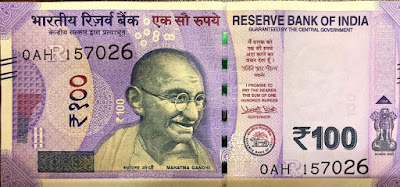 Rohit Kumar, a colleague from SBI and a prominent Numismatist, Banknote Collector and Philatelist has sent me images of a Rs.100/- Banknote, bearing Serial No. 0AH 157026" issued with an "R" Inset and exhibiting all the design elements in the newly introduced Rs.100/- Banknotes. This Banknote has been issued in "2018" under the signatures of Dr. Urjit R. Patel, present RBI Governor
The Back of the above Banknote exhibits all the design features described above and bears the Year of issue as "2018.
Posted on 01.12.2018:
I have been tapping my vast network of Banknote providers - provision shops, malls, friends, street-side vendors etc. to help me with my collection of new Rs.100/- Banknotes. These Banknotes are still in very short supply.
I checked up with a new provision store yesterday, if he could exchange a new design Banknote for an old design one. He nodded in the affirmative and then went to the rear of the shop and got the undernoted Banknote for me. Apparently, he did not want to have a flood of requests from his other customers for the new design Rs.100/- Banknotes. This is my first Banknote with an "E" Inset:
 The Front of this Rs.100/- Banknote bears the Serial no. "5AP 609532" and it has been issued with an "E Inset". It exhibits all the design element features introduced in the new design Banknotes
 The Back of the above Rs.100 Banknote exhibits all the recently introduced design features in this denomination and bears the year of issue as "2018"
Posted on 22.08.2019:
Zaheer Hasan, an avid Banknote Collector has sent me the following images of Banknotes in his collection which bear the signatures of present RBI Governor, Shri Shaktikanta Das and have been issued in 2019:
 The Front of this Rs.100/- Banknote bears the serial no. "8AF 000041" and has been issued with a "Plain Inset". It exhibits all the design element features introduced in the Mahatma Gandhi "New" Series of Banknotes of this denomination. This Banknote bears the signature of Shri Shaktikanta Das, present RBI Governor and has been issued in 2019
Posted on 03.05.2016:
I have received my first new design Rs.100/- Banknote from Ankita who has contributed this Banknote for my collection. This Banknote exhbits all the recently introduced features - "Exploding Font" or "Ascending Serial Numbers", Four "Bleed lines" on either side of the front of the banknote, bigger visual identification Assist "triangle" which has been shifted upwards from previously issued Banknotes etc. These enhanced security features have "raised the bar for counterfeiters". Get ready to use similar Banknotes in the coming days:
The Front of a Rupees 100 Banknote exhibiting all the recently introduced features - Four Bleed lines in a "2 - 2" format, Exploding Font or Ascending Serial number "5AD 589081" (the Banknote has an "E" Inset).

The Back of the above Banknote exhibits the identical features of Banknotes already/presently in circulation. The year of issued is marked as "2015".
Posted on 09.05.2016:
These Banknote images have been contributed by Zaheer Hasan for illustration:
Given below is an image of a Rs.100/- Banknote issued in the earlier design but bearing the year of issue as "2016":


It seems that you may also come across some Banknotes in the earlier design format during 2016 , till such time that all the SPMCIL/RBI Printing Presses have been migrated/switched over to the new Design.


The Front of the above Banknote which has been issued with the Serial Number - "6CH 825346" with an "R" Inset in the new design format, with exploding fonts and four Bleed lines during 2016.

Posted on 02.06.2016:
I have acquired a Rs.100/- Banknote with an "E" Inset and the new design, yesterday from a Provision Store merchant bearing the year of issue as 2016:


Posted on 25.07.2016:
The undernoted Star Series Banknotes have been sent to me by Zaheer Hasan for illustration.
These are from the new Series of Banknotes issued with four Bleed lines on both sides of the Front of the Banknotes and also exhibit the "Star" Serial numbers:


Posted on 20.09.2016:
Zaheer has sent me this interesting Banknote image of an error Banknote from his collection, a few days ago:


Posted on 09.11.2016:
Fighting
Black Money in India:
After the recently closed Black
Money Voluntary Disclosure Scheme, which closed on end September 2016, the
Government of India has brought in a
major step on 08.11.2016 in its war against corruption, terrorism and black
money.
Before the present Government
took over the reins of Government about two years ago, India ranked around 100
in global rankings of corruption. Presently, it ranks 76th.
Black Money estimated at about
Rs.1.25 lakh crores has been brought back to India according to Indian Prime
Minister Narendra Modi. Nevertheless,
this is not an exemplary position to be in, as such, the Government has taken
some drastic measures:
The Indian Prime Minister
Narendra Modi in a televised address to the nation on 08.11.2016 evening announced
the demonetisation of the presently circulating higher denominations of
currency viz. Rs.500/- and Rs.1000/- with effect from the coming midnight i.e.
midnight of 08.11.2016. He stated that the Banknotes of these denominations
will “just be worthless pieces of
paper”. The Banknotes of all the lower denominations of Rs.100/-, Rs.50/-,
Rs.20/-, Rs.10/-, Rs.5/-, Rs.2/- and Re 1/- and all coins will continue to be
accepted as legal tender. In addition, new Banknotes in the denominations of
Rs.2000/- and Rs.500/- will be introduced.
Also,
there will be no change in any other form of currency exchange i.e. cheques,
Demand Drafts, credit card or debit card payments.
This has been necessitated
as the Government has been fighting the menace of black money and corruption
over the past two years when it was voted to power.
To
facilitate the smooth transition to the new money regime, Banks will be closed
on 09.11.2016.
Presently, Rs.500/- and
Rs.1000/- Banknotes which have been demonetised account for 86.4 % of the total
value of Banknotes which were in circulation as of 31.03.2016.
Some
instances, where the Rs.1000/- and Rs.500/- old Banknotes can still be used:
Existing Rs.500/- and Rs.1000/- Banknotes will be accepted till
11.11.2016 at Government hospitals, pharmacies in Government hospitals (with
prescriptions), Railway counters, Government buses, Airline counters, petrol pumps,
Cooperative stores run by Government, milk booths of State agencies, crematoria
and burial grounds.
The
result of this announcement:
I saw huge crowds of four
wheelers and two wheelers at petrol pumps which stayed open, but several petrol
pumps closed before time.
Two Shopping Malls in the
vicinity of my residence remained open till midnight and saw unprecedented rush
of shoppers, as Banknotes of Rs.1000/- and Rs.500/- denominations remained
legal tender till midnight of 08.11.2016.
Several persons stood
patiently in serpentine queues to withdraw small denomination Rs.100/- Banknotes
to meet their expenses over the next few days, as a result, several ATMs went
out of cash.
What
else?
On 9th and 10th
November 2016, ATMs will not work,
as smaller denomination banknotes will be arranged for by the ATM Management
Groups/Banks.
All
Banks will remain closed on 09.11.2016.
From
10.11.2016 to 31.12.2016, customers can deposit Banknotes of Rs.500/- and
Rs.1000/- in any Bank or Post Office. However, there is a condition
– the depositor will have to show a proof of identity. One can deposit any
amount into one’s own account, but if KYC documents have not been submitted,
the limit is Rs.50,000/-
This
condition will be relaxed somewhat, as after 31.12.2016, one can still deposit
old Banknotes with valid ID proof at specified offices of RBI, to be intimated later, till 31.03.2017.
No
restrictions on payments by cheques, DD, debit/credit cards & Electronic Fund Transfer (EFTs) has been made.
From 10.11.2016, Banks and Post Offices will operate for extended hours to
facilitate the unprecedented rush of deposit of the cash into deposit accounts.
The exchange facility is available at all Issue Offices of RBI and branches of commercial banks/RRBS/UCBs/State Co-op banks or at any Head Post Office or Sub-Post Office.
The exchange facility is available at all Issue Offices of RBI and branches of commercial banks/RRBS/UCBs/State Co-op banks or at any Head Post Office or Sub-Post Office.
Depositors
can withdraw up to Rs.2,000/- per day per card from ATMs till November 18 and
Rs.4,000/- per day per card after this date.
The ATMs will resume functioning from November 11, 2016 upon their recalibration to dispense bank notes of the denominations of Rs.50/-, Rs.100/- Rs.500/- and Rs.2,000/-
Further, so as to ensure customer convenience, banks are also advised to provide all cash withdrawal transactions at their ATMs free of cost to their customers till 30 Dec 2016. It has also been decided that banks may fix a limit of Rs 2000/- per day per card withdrawal limit at ATMs, for all their customers, till November 18, 2016. For deposits being made at Banks and other establishments, please note, that one will get upto ₹4000 per person in cash irrespective of the size of tender and anything over and above that will be receivable by way of credit to bank account.
The ATMs will resume functioning from November 11, 2016 upon their recalibration to dispense bank notes of the denominations of Rs.50/-, Rs.100/- Rs.500/- and Rs.2,000/-
Further, so as to ensure customer convenience, banks are also advised to provide all cash withdrawal transactions at their ATMs free of cost to their customers till 30 Dec 2016. It has also been decided that banks may fix a limit of Rs 2000/- per day per card withdrawal limit at ATMs, for all their customers, till November 18, 2016. For deposits being made at Banks and other establishments, please note, that one will get upto ₹4000 per person in cash irrespective of the size of tender and anything over and above that will be receivable by way of credit to bank account.
Thereafter,
one can withdraw up to Rs.10,000/- per day and Rs.20,000/- per week either through withdrawal slips, cheques or through ATMs from Banks
till 24.11.2016. After this date, the limit will be raised.
Depositors
can withdraw up to Rs.2,000/- per day per card from ATMs till November 18 and
Rs.4,000/- per day per card after this date.
Freshly
designed Banknotes of Rs.500/- and Rs.2000/- with chips in them will be
introduced on Thursday, i.e. 10.11.2016.
One can contact the
following RBI & Government helpline numbers for any query – 022-22602201
and 022-22602944 (RBI) and Ministry of Finance: 011-23093230.
Property
prices could drop substantially in the secondary market, as there is an
estimated 60:40 (Legal-to-Black money ratio) in operation as at present.
This step is also aimed at
stamping out the menace of corruption and terror funding, as terrorists from across the border have been using fake currency
notes.
A
word of caution:
One can also deposit the
demonetised currency in someone else’s account with written authorisation and one’s
ID proof.
The
Government/RBI has cautioned citizens against exchanging other person’s
unaccounted cash at Banks/Post Offices. Security cameras will monitor transactions
at branches and the exchange will be recorded.
Introduction
of the new denominations of Rs.2000/- and R.500/-:
Reserve Bank of India has
yet to decide the limit for individuals for possession of Banknotes of higher value i.e. Rs.2000/- and
Rs.500/- which will be put into circulation from 10.11.2016.
 The Front of the new Rs.2000/- Banknote which is now going to be in circulation wef 10.11.2016
 The Back of the new Rs.2000/- Banknote shows the Mangalyaan which is the Mars Orbiter
 The Front of the new Rs.500/- Banknote which is now going to be in circulation wef 10.11.2016
 The Back of the new Rs.500/- Banknote shows the Red Fort in New Delhi
The
salient features of the new Rs.500/- Banknotes are:

The
salient features of the new Rs.2000/- Banknotes are:
The Series will be called
the Mahatma Gandhi (New) Series.
The Banknotes will bear
the signatures of Dr. Urjit R. Patel, RBI Governor.
The year of printing will
start from 2016 which will be printed on the Back of the Banknote.
Other
important features of the Banknote:
On
the Front: See through Register with
denominational numeral 2000
Latent image
with denominational numeral 2000
Denominational numeral
2000 in Devnagri
Portrait of Mahatma Gandhi
at the centre
Micro letters
“RBI” and “2000” on the left side of the Banknote
Windowed security thread
with inscriptions “Bharat” (in Hindi), RBI and 2000 on Banknotes with colour
shift. Colour of the thread changes from green to blue when the Banknote is
tilted
Guarantee Clause, RBI
Governor’s signature with Promise Clause and RBI emblem
towards the right
Denominational numeral
with Rupee symbol “R 2000” in colour changing ink (green to blue) on bottom
right, Ashoka Pillar emblem on the right.
Watermarks: Mahatma
Gandhi portrait and electrotype (2000).
Number panel with
numerals growing from small to big on the top left side and bottom right side
For visually impaired:
Intaglio or raised
printing of Mahatma Gandhi portrait, Ashoka Pillar emblem, Bleed lines and
identity marks.
Horizontal rectangle with
“R2000” in raised print on the right.
Seven angular bleed lines
on the left and right side in raised print
Other features:
Year of printing
on the Banknote on the left
“Swachh Bharat” logo
with slogan
Language Panel
towards the centre
Motif of Mangalyaan
Denominational numeral
“2000” in Devnagri
Size/Dimensions
of the Banknote: 166 mm x 66 mm


The Series will be called
the Mahatma Gandhi (New) Series.
The Banknotes will bear
the signatures of Dr. Urjit R. Patel, RBI Governor.
The year of printing will
start from 2016 which will be printed on the Back of the Banknote.
On
the Front: See through Register with
denominational numeral 500
Latent image
with denominational numeral 500
Denominational numeral 500 in "Devnagri"
Portrait of Mahatma Gandhi
at the centre
Micro letters
“RBI” and “500” on the left side of the Banknote
Windowed security thread
with inscriptions “Bharat” (in Hindi), RBI and 500 on Banknotes with colour
shift. Colour of the thread changes from green to blue when the Banknote is
tilted
Guarantee Clause, RBI
Governor’s signature with Promise Clause and RBI emblem
towards the right
Denominational numeral
with Rupee symbol “R 500” in colour changing ink (green to blue) on bottom
right, Ashoka Pillar emblem on the right.
Watermarks: Mahatma
Gandhi portrait and electrotype (500).
Number panel with
numerals growing from small to big on the top left side and bottom right side
For visually impaired:
Intaglio or raised
printing of Mahatma Gandhi portrait, Ashoka Pillar emblem, Bleed lines and
identity marks.
Horizontal rectangle with
“R500” in raised print on the right.
Five angular bleed lines
on the left and right side in raised print
On the Back:
Year of printing
on the Banknote on the left
“Swachh Bharat” logo
with slogan
Language Panel
towards the centre
Motif of Red Fort, New Delhi
Denominational numeral
“500” in Devnagri
Size/Dimensions
of the Banknote: 150 mm x 63 mm


Posted on 29.11.2016:
The following Rs.100/- Banknote has an interesting twist about it. See if you can spot the "error":


Posted on 15.12.16:
The undernoted image of an error Rs.100/- Banknote, issued by the previous RBI Governor, Raghuram G. Rajan exhibit some interesting features. This Banknote is in the collection of Sushil, my SBI colleague and batchmate from 1982:

Posted on 28.01.2017:
The following Banknote has been acquired by me yesterday and is from the latest RBI releases of Rs.100/- issues vide their Press Notification dated 06.12.2016 and which are the first ones that bear the new RBI Governor Urjit R.Patel's signatures in this denomination:


A new trend is emerging in recent issues of Currency (already seen on Rs.1000/- and Rs.500/- Banknotes) and Postal Covers - (First Day Covers and Special Covers) that the "Swacchh Bharat Mission" logo is being carried on recent issues. So far denominations of Rs.100/- and below still exhibit identical designs as the earlier issues. But it would be interesting to watch, what happens in the future.
Posted on 03.07.2017:
I have collected the undernoted Rs.100/- Banknote from a Provision Store today. Interestingly, this is only the second issue of Banknotes of this denomination after the above-referred issue circulated in 2016, and the first one in 2017, which have been circulated under the present RBI Governor Urjit R. Patel's signatures. These Banknotes have been issued with an "R"Inset and their circulation has been notified as legal tender by RBI vide their Press Release dated 03.02.2017:


Posted on 06.07.2017:
I collected the undernoted Rs.100/- Banknote (issued in 2017) from a Bank ATM only yesterday.
Recent Banknote issues of various denominations are coming out so fast off the Printing Presses, that RBI Press releases which are put up on RBI website, before the release of a new Banknote, are not able to match the output of the Printing Presses and keep pace. As a result, no Press notification has been released for this Banknote (issued with a "Plain" Inset in 2017), confirming that these notes are legal tender.


Posted on 02.06.2018:
I was looking at all the Banknotes in my purse to see if there was any note which could go into my collection. I had almost glossed over the following Banknote thinking that the year of issue was 2016, but upon checking under the powerful magnifying glass on my desk, I was rather surprised to see that the year of issue on this Banknote was "2018".
As RBI has a few months ago done away with the practice of issuing Press Notifications regarding putting currency note into circulation except macro-level policy decisions on currency Note issues and even withdrawn all the circulars related to the November 2016 demonetisation of Rs.1000/- and Rs.500/- Banknotes as well as most of the later Banknote issues from their website, it is difficult to assess/find out what newly printed Banknotes have been actually put into circulation and whether the ones in your hand/pocket are actually "legal tender" or "counterfeit issues", unless the Banknotes in hand are physically examined:


Posted on 19.07.2018:
The Reserve Bank of India vide their Press Release 2018-2019/174 dated Thursday 19.07.2018 has notified that it would issue new Rs.100/- Banknotes shortly, bearing the signature of RBI Governor Dr. Urjit R. Patel.
The new Banknote will be in the base colour of lavender and will have a motif of Rani-Ki-Vav (a heritage site (stepwell) located in Gujarat on the Back of the Banknote. The Banknote has other designs, geometric patterns aligning with the overall colour scheme, both on the Front and Back.
The Dimension of the Banknote will be 66.0 mm x 142 mm.
The existing Banknotes of Rs.100/- denomination would continue to be legal tender.
The salient features of the Banknotes would be:

Front (Obverse):
1) See through register with denominational numeral 100
2) Latent image with denominational numeral 100
3) Denominational numeral "100" in Devanagri
4) Portrait of Mahatma Gandhi at the centre
5) Micro letters "RBI", Bharat (in Hindi), "India" and "100"
6) Windowed security thread with inscriptions "Bharat" (in Hindi) and "RBI" with colour shift. Colour of the thread changes from green to blue when the Banknote is tilted
7) Guarantee clause, Governor's signature with Promise Clause and RBI emblem towards right of Mahatma Gandhi's portrait
8) Ashok Pillar emblem on the right
9) Mahatma Gandhi portrait and electrotype (100) watermarks
10) Number panel with numerals in ascending font on the top left side and bottom right side
11) For visually impaired persons, intaglio or raised printing of Mahatma Gandhi's portrait, Ashok Pillar emblem, raised triangular identification mark with micro-text 100, four angular bleed lines both on the right and left sides

Back (Reverse):
1) Year of printing of the Banknote on the left
2) Swachh Bharat logo with slogan
3) Language Panel
4) Motif of "Rani Ki Vav" Stepwell
5) Denominational numeral "100" (in Devanagri)
Posted on 30.07.2018:
I acquired the following Banknote at the MTDC Crater/Lake outlet at Lonar during our recent trip to visit the Lonar town:


Posted on 21.09.2018:
I have finally managed to collect a new design Rs.100/- Banknote after visiting several ATMS, Banks, shopping outlets etc. from Raje who was at the cash counter of the Farmer's Co-operative outlet in the vicinity. He said he had collected it to show his son, but on hearing that I am a Collector, took front & back photos on his mobile to show his son and gave this Banknote to me for my collection ad sharing on my Blog. He has promised to keep some mint condition Banknotes for me, as he had folded this one to keep in his purse:

Notice that the Blind Identification Intaglio Triangle has shifted to the right along with the RBI emblem. Several other features, like the designs on the left have been added, the name of the issuing Bank : "Bhartiya Reserve Bank" (in Hindi) has moved to the top left side, while " Reserve Bank of India" (in English) now appears on the top right.
In between is the denomination of the Banknote in words in Hindi only "Ek Sau Rupiye", while the numeral " 100" appears in both Hindi and English with the Rupee symbol on both sides. The Mahatma Gandhi image has moved to the centre and now faces right. This Banknote has been issued under the signatures of present RBI Governor Urjit R. Patel.
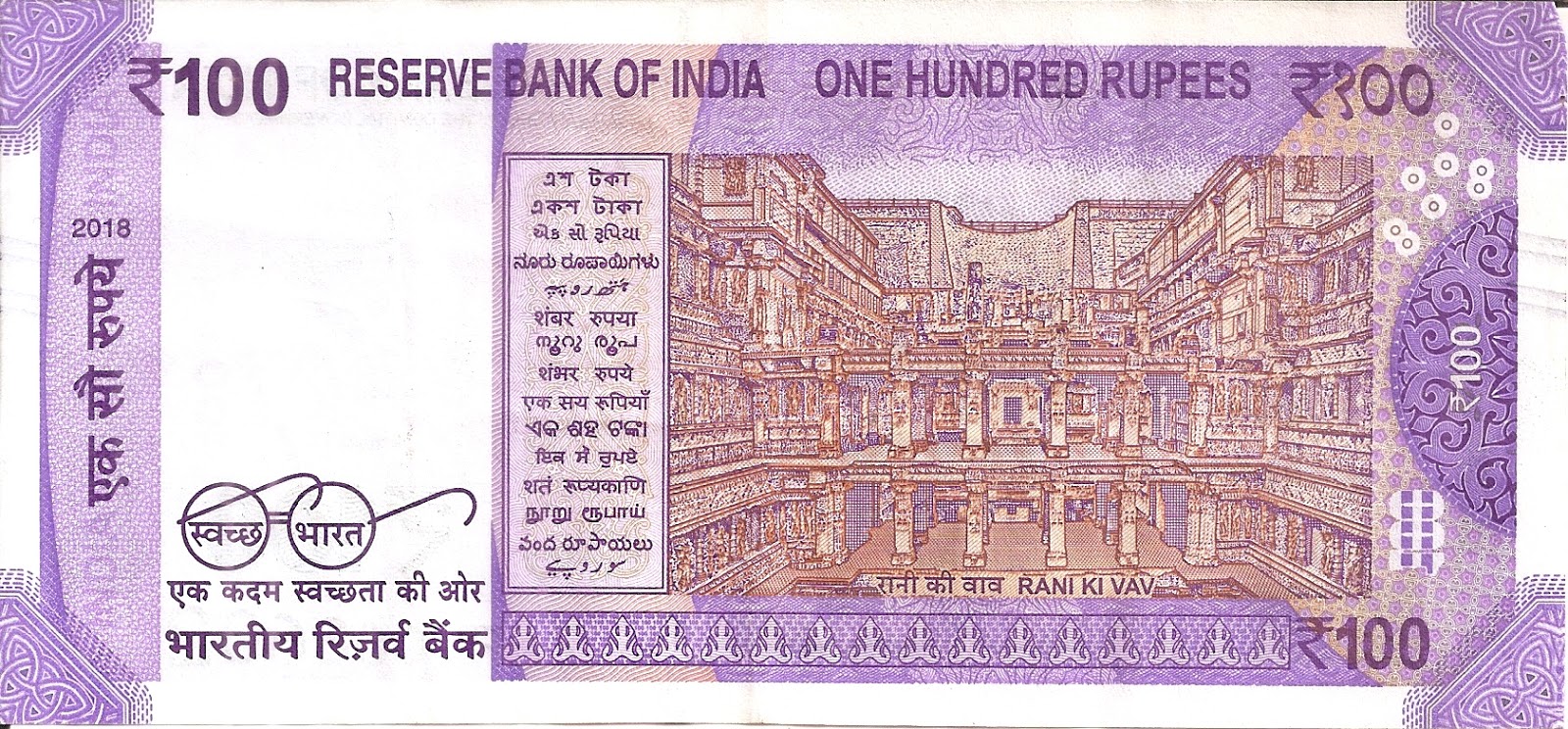
"Rani Ki Vav" Stepwell, Patan: This Stepwell is 64.0 metres long, 20.0 metres wide and 27.0 metres deep with an intricate construction and a beautiful carving featuring the Hindu Gods. Constructed in the Maru-Gurjara architectural style with an inverted temple and seven levels of stairs and holds more than 500 principal sculptures. This Stepwell is recognised by UNESCO as a World Heritage site on 22.06.2014.
"Rani Ki Vav" means the "Queen's Stepwell" and is situtated in the town of Patan in the India state of Gujarat. This intricate Stepwell wes built around 1050 AD by the Queen of Bhimdev I of the Solanki Dynasty.
Rani Ki Vav was awarded the title of "Cleanest iconic Place" in India at the Indian Sanitation Conference (INDOSAN) 2016 held in New Delhi in October 2016.
"Rani Ki Vav" also featured in a Stamp Series titled "Stepwells of India" brought out by India Post on 29.12.2017, which featured 16 prominent Stepwells located all over India. My post on this Stamp issue can be visited at the following link: Stepwells of India: A set of 16 Stamps brought out by India Post on 29.12.2017

Posted on 01.12.2018:
I have been tapping my vast network of Banknote providers - provision shops, malls, friends, street-side vendors etc. to help me with my collection of new Rs.100/- Banknotes. These Banknotes are still in very short supply.
I checked up with a new provision store yesterday, if he could exchange a new design Banknote for an old design one. He nodded in the affirmative and then went to the rear of the shop and got the undernoted Banknote for me. Apparently, he did not want to have a flood of requests from his other customers for the new design Rs.100/- Banknotes. This is my first Banknote with an "E" Inset:


Posted on 22.08.2019:
Zaheer Hasan, an avid Banknote Collector has sent me the following images of Banknotes in his collection which bear the signatures of present RBI Governor, Shri Shaktikanta Das and have been issued in 2019:


Posted on 31.01.2021:
I must confess that the year 2020 was a pretty bad year on account of the Chinese Wuhan Virus pandemic. I stayed indoors mostly, as a result my sharp reflexes on picking out "*" (Star Series) Banknotes had got somewhat dulled a bit. Normally, I am on the lookout for star Series Banknotes for my collection, but on the other hand, I had not noticed the "Star" on this Banknote signed bythe present RBI Governor Shri Shaktikanta Das and was about to give it out in payment at the Tata"s "Star" Hypermarket. I caught myself just in time to hold back this Banknote.
To reiterate what is a Star Series Banknote?
Whenever defective notes are printed, particularly from Rs.10/- to Rs.100/- denominations, the Security Printing Presses have adopted a “Star” series numbering system for replacement of these defectively printed Notes.
The numbering on the replacement Notes is exactly like the normally printed ones, but have an additional feature i.e. a “STAR” (*) is added in the serial number in the space between the prefix and the number.
The main significance of these notes, besides the “STAR” is that, although, these notes would be issued in packets of 100 each, these bank notes would not be serially numbered.
To enable easy identification, the bands on these packets will clearly indicate that the packet contains star-series banknotes. The notation on the band of such note packets normally is “contains non-serially numbered notes with * in the number panel”, both in Hindi and English.
The numbering on the replacement Notes is exactly like the normally printed ones, but have an additional feature i.e. a “STAR” (*) is added in the serial number in the space between the prefix and the number.
The main significance of these notes, besides the “STAR” is that, although, these notes would be issued in packets of 100 each, these bank notes would not be serially numbered.
To enable easy identification, the bands on these packets will clearly indicate that the packet contains star-series banknotes. The notation on the band of such note packets normally is “contains non-serially numbered notes with * in the number panel”, both in Hindi and English.

The Back of the above Banknote bears the year of issue as "2019".
Links to other posts on Indian Currency denominations on this blog:
1) Introduction of the new Rs.2000/- denomination in Indian Currency circulation wef 10.11.2016
2) Classification and Valuation of Rs.1000/- denomination Banknotes
3) Classification and Valuation of Rs.500/- Banknotes
4)Classification and Valuation of Rs.100/- Notes
5) Classification and Valuation of Rs.50/- Notes
6) Classification and Valuation of Rs.20/- Notes
7) Classification and Valuation of Rs.10/- Notes
8) Classification and Valuation of Rs.5/- Notes
9) Evolution and Valuation of one Rupee Banknotes in India
10) Did-you-know-series-1: Assists for identification of Currency Notes by visually challenged users
11) Did-you-know-series-2-what-is-design-or focus of the picture at the back of circulating Currency Notes in India?
12) Are you carrying a Fake Rs.500/- Banknote in your purse/wallet?: A comprehensive study
13) Introduction of a Rs.200/- Banknote wef 25.08.2017: Reasons for introduction, Necessity & convenience to Users
Some interesting links on Indian coins on this Blog:

A very detailed and informative post, good work!
ReplyDeleteThank you so much.
ReplyDeletei have a 100 rs note of hvr sign on it plz tell me the value..
ReplyDeletemail me the details at amansinghtsk007@gmail.com
ReplyDeleteHi Aman, I have sent a reply today to your email address. I hope you find it useful.
ReplyDeleteHi I m having an 100 Rs note containing a “star” * in the number panel, issued in 2011 with an “L” Inset.. Pls share the value .. kamal_del_in2000@yahoo.com
ReplyDeleteHi Kamal,
ReplyDeleteI have sent you a message today on your given email address. I hope you find it useful.
the 100 rs note of hvr sign i wnt to sell it.. where to sell it n at wht price or should i wait for fetching some good money for it...!!
ReplyDeleteHello Aman, Banknotes can be purchased or sold at Currency dealers outlets or currency exhibitions like the ones which are held in Pune almost every month or on auction sites like ebay. The timing can never be matched to perfection like the "stock market" and depends on the availability of a particular type of currency note as well as the "buyers" requirement of a particular issue for his collection. So you will have to go by your own judgment. Of, course, the older a mint condition Banknote gets, the more it is likely to gain in value.
ReplyDeleteWhat's up everyone, it's my first go to see at this
ReplyDeleteweb page, and article is really fruitful designed for me, keep up posting these posts.
my homepage; marathon runner bracelet
you mentioned "Notes issued under Dr. Jalan’s signatures in mint fresh condition are valued by Collectors at anywhere between Rs.250/- to Rs.350/- (for the later issues and Rs.300/- to Rs.500/- (for the earlier issues)." Since these are still valid notes and available in plenty, why do collectors pay more..what is the significance/value?
ReplyDeleteHello Anonymous,
ReplyDeleteEvery year Banknotes are brought out under different Serial numbers. First with a Plain Inset, then with several Insets say "A", "N", "L" "S" etc. Once the Serial number runs its course, then this Serial number under this Inset will never be printed again. As time passes by, most of these notes get circulated and worn out with use, however, some mint condition Notes remain in the possession of users and these acquire value for collectors, akin to vintage cars, and more so, if a number of RBI Governors has changed. Shortly, the demonetisation of currency issued prior to 2005, i.e. the year after which the printing year is mentioned will bring out many unused Banknotes, which collectors will take into possession with a lot of interest - the best part being all acquired at face value. Not only will these help build up collections, but they will all acquire value over time.
Thanks very much for the insight. Due to the demonetisation of pre-2005 curreny, i have also started using the unused notes. But reading your inputs made me keep them. At the minimum price of Rs.250 apiece in mint fresh condition, it is worth more to give to collectors. Thanks once again for the informative website.
ReplyDeleteI have a collection of mint fresh notes of Dr.Jalan, for sale
ReplyDeleteHello Krishna,
DeletePlease mention your email address and/or mobile number, so that interested collectors may get in touch with you.
phalgunekk@gmail.com 9047350000
DeleteInformative post.thanks for share. Advertising is one of the most influential mediums to promote your product across the globe. All you need is a right site to create the right impact at the right time.
ReplyDeleteTo get more information visit once www.kebhari.com.
Satyajit Pratap has commented on the new design serial numbers:
ReplyDelete"Amazing Rajeev.....your updates are wow"
Thank you, Satyajit. Its just that I have time on my hands for a full-scale research and friends who help me out with the specimens. I am now looking for a packet of one rupee notes which have been re-issued in 2015 & have already hit circulation.
DeleteRamchandra Lalingkar has commented on the new design serial numbers:
ReplyDelete"Novel method. RBI is improving its efforts to guard against counterfeiting."
Yes, Lalingkar Sahab. Collectors are wondering why it did not start with the Rs.1000/- Banknotes. Could it be that the Government proposes to do away with higher denomination notes, in an effort to fight the incidence of black money , like in several countries where the highest denomination is 100 or 50. Let us see what the future holds.
DeleteDennis Ksing has commented on the new design serial numbers::
ReplyDelete"Hi Rajeev, I've also received some of these bank notes and was going to ask you about them. They are now in safe keeping".
The first few ones are the ones to keep as specimens. Also, this makes all Raghuram Rajan Rs.100/- Banknotes issued earlier in 2015, rather interesting collectibles, as being the last few in the old design numbering.
DeleteI HAVE VISITED THIS SITE FIRST TIME TODAY ITS VERY GREATE THING VERY USEFUL INFORMATION WITH IT I AM ALSO HAVING SOME NOTES EVEN SOME ERROR NOTES ALSO, LIKE MISSING NO., OVER PRINT AND ALSO A FIVE RS NOTE OF C RANGARAJAN WITHOUT PRINT BACK. SITE
ReplyDeleteI HAVE A SPECIAL NOTE I WANT TO SELL IT
ReplyDeleteMY E MAILIS -JAYTHAKUR1903@GMAIL.COM
Hello Aaditya,
ReplyDeleteYour comment is not very clear. If you are trying to find a buyer for your banknote, you will have to give more details like condition of the Note, Year of minting/RBI Governor etc. about the Banknote and your contact details.
RAJEEV JI VERY GLAD TO SEE UPDATE AT 100 & 500 BLOGS AFTER A LONG TIME 1000 ALSO REQUIRES YOUR ATTENTION, THERE IS ALSO L INSERT IN BLEED 2015 AND WITHOUT INSERT 2016 CIRCULATED AND YOUR COMENTS ON 3AP
ReplyDeleteI am waiting for your commentes /findings on my last email sent to you. Only after hearing from you on your detailed findings, I will revert to the 3 AP Banknote.
DeleteTHANKS A LOT MR RAJEEV
ReplyDeleteYou are welcome, Zaheer.
Deletei have very old 10rs, 5rs, 100rs note.. anyone interest to buy call me this is my number 9043253627
ReplyDeleteHave got 2 notes of
ReplyDeleteRs.100/- Banknote from the collection of Jayant Biswas.
This Banknote was issued during the tenure of RBI Governor I.G.Patel (01.12.1977-15.09.1982) with an "A" Inset.
The Back of the Banknote depicts the Hirakud Dam and Hydroelectric station.
Selling Price : Rs.800/-
Contact : busapriyank@gmail.com
Phone: 9320329469
Location : Mumbai
i have 100 rs note signed by Dr. Manmohan singh farming seen back side . used note .. could u please tell me is it valuable ??
ReplyDeleteReply me on my mail id md.manishdarjee@gmail.com
Hello Manish,
DeleteYou could check up on eBay at the link which I am giving below to arrive at an assessment of your Banknote after analysing the giving quotes and watching this site over a few days:
http://www.ebay.in/sch/i.html?_sacat=0&_nkw=100+rupees+note&rt=nc
thanks for ur valuable reply .
ReplyDeletebut i didnt find any note with the sign of Dr. manmohan singh on this site ..
so i can not assest this ..
You will, sooner or later. As per my assessment in 2011, when I wrote this post for the first time, a mint condition new Banknote signed by Dr. Manmohan Singh was worth about Rs.500/-. However, prices of Banknotes depend mostly on the requirement of a buyer to have a Banknote in his possession and the seller's assessment, hence prices are mostly relative, as such, if you continue to watch the site, you will get a fair assessment of its present day value/quotes.
DeleteThankyou Mr Rajeev
ReplyDeleteGreat collection sir...
ReplyDeleteThank you so much for your encouraging comment. Much appreciate.
DeleteComment on the D.Subbarao Banknote printed with a 2014 year of issue:
ReplyDeleteSanjay Randhar has commented:
"Interesting.. I'm sure this is not a counterfeit one"
Sanjay, these Banknotes have been taken on all the leading websites on Banknotes. I have managed to get this Note through a fellow collector who got this in Delhi. Everything matches up under UV Ray light examination.
DeleteComment on the D.Subbarao Banknote printed with a 2014 year of issue:
ReplyDeleteRattan Nath has commented:
"Right now there are loads of error loaded notes out there. If the pressure to print continues, collect them. The bank will eventually come around to weeding them out and destroying them--and give you a nice profit."
Rattan, these Banknotes have been in circulation from around March 2016, Rattan. I have been looking for this one since then. However, you are absolutely right. The cash crunch and long queues at Bank branches have got Bankers paying out even old currency with the Ashok emblem and signatures of RBI Governors from the 1990s etc. which have been demonetised since June 2015. Petrol pumps and other outlets are accepting Indian Banknotes of all denominations so as to co-operate with the public. When Bank branches are going "cash-out' they are giving bags of Rs.10/- denomination coins as an alternative.
DeleteRattan Nath has further commented:
Delete"Reportedly some of the new notes are not of uniform size and there are printing irregularities on many of the 500 rupee notes--not proofed carefully enough in the pressure situation."
I have'nt seen 500 notes yet, Rattan. Nevertheless, this would be a collector's delight.
DeleteRattan Nath has further commented:
Delete"Are notes with errors a variety of black money? Check out this piece about printing sub-standard notes--read notes with errors that are deliberately tolerated: https://www.thequint.com/.../security-scandal-new-rs-500...
Very interesting, Rattan. The normal practice is that error Banknotes are taken out at inspection level and replaced with correctly printed ones. Later packets of non-serially numbered Banknotes which represent the error Banknotes are printed, but with a * in their Serial numbers. The number of such error notes, helps a Banknote printing press to keep tabs on who was responsible for the errors and take corrective measures. The non-serially numbered * Series packets command a huge premium in the Collector's market. Now the four printing presses are working three shifts as against the normal two shifts every 24 hours. This will definitely result in several processes being given a go by and several error notes being put into circulation. The machines will also get over-heated and result in break-downs. Also, 11 years worth of High denomination Banknotes representing 86 % of currency in operation has been taken out. So far only 20% 2000/- Rupee Notes and 10% 500 Notes have been printed. The whole process will take a minimum of 7 to 10 months. I saw a customer paying for a Rs.10/- biscuit packet with a crredit card yesterday. He had no cash - not out of his progressive outlook, but because there was no money in the ATMs he visited.
DeleteOn the recently introduced 100 Rupee Banknote signed by RBI Governor Urjit Patel which I have put up on 28.01.2017:
ReplyDeleteRattan Nath has commented:
"Need more inflation for the logo to promote its use as toilet paper. Right now it is not valuable enough to make a toilet and too valuable to be used in a toilet."
Cool. Could'nt stop laughing, Rattan. But on a serious note, a telling commentary!
DeletePushkin Sinha has commented:
Delete"Great your sharing of knowledge."
Thank you, Pushkin.
DeleteSir I need help ..I want to know price of 100 rs signed by s.venktaeshraman
ReplyDeleteHello Aman,
DeleteYou could check up on eBay at the link which I am giving below to arrive at an assessment of your Banknote after analysing the giving quotes and watching this site over a few days:
http://www.ebay.in/sch/i.html?_sacat=0&_nkw=100+rupees+note&rt=nc
Hi have a 100 note having "A" inset. The governor name is M. Narsingham.
ReplyDeleteTell me if i can sell it. Shakiralikhan13@gmail.com
I hav 100rs note, signed by c rangarajan. 4SH 066316. For sale.
ReplyDeletePlz contact me at 8340344869 or mail me on dubeysuraj48@gmail.com
I have series symbols minimums values sell coins notes contact numbers 8160251475
ReplyDeleteVikram Bhatnagar has commented on the new design Banknote and me posting dated 21.09.2018:
ReplyDelete"Befitting description of a pretty note.
I'm getting the feeling that, all considered, the note is worth more than the nominal value ascribed to It! 👍🤔"
If only one thinks about the background initiatives which have gone into the choice of "Rani Ki Vav" , instead of thinking, "Oh another icon from the PMs favourite Gujarat." :-) I am just trying to put things in the right perspective from RBI's point of view. As you have mentioned, Vikram, the first few Banknotes in mint fresh condition are indeed "priceless" Collector's items.
DeleteSir please tell me 2016 URJIT PATEL 100 Rs. Prefix 5AC inset-E value
ReplyDeleteSurendra15051967@gmail.com
Thank you so much for visiting my blog and writing to me. I have not been keeping up with the latest valuations of Indian Banknotes. As Banknote valuations vary from time to time, I would suggest that you to visit a website like eBay, OLX or QUIKR and arrive at an average present day valuation for your Banknote.
DeleteThanks for sharing. Especia Associates provide Registered Valuer consultants. Registered Valuer has been through thorough training in framing reliable and helpful valuation reports. There is no second thought in approaching trusted Registered Valuers as they have been officially certified to take up the valuation responsibilities. if you need Registered Valuer call at 9310165114 or visit us Registered Valuer
ReplyDeleteThanks For Sharing. Especia Associates provides RBI Valuation Consultants. RBI Valuation is essential to survive in the Stock Market business. The guidelines offered to RBI Valuation can be handled effectively by SEBI registered chartered accountants, who will carry out the RBI valuations effortlessly. Consulting the right RBI Valuation firm is the key to get the valuation done right. if you need RBI Valuation Services call at 9310165114 or visit us RBI Valuation Services
ReplyDeleteAll information outstanding while I read your blog articleTop 10 Fashion Designing Institute in Delhi ,
ReplyDeleteBest Fashion Designing courses in Delhi NCR
#Top10FashionDesigningInstituteinDelhi
#BestFashionDesigningcoursesinDelhiNCR
Pass purane ₹100 ka note hai ismein 776 number hai aapko yah note chahie to mujhe call karo number hai 7454 964501
ReplyDeleteMain balakot mein rahata jo Uttrakhand mein hai district Pithoragarh jila hai